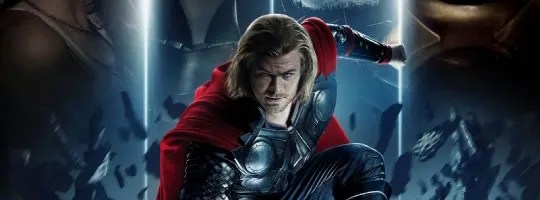
I originally wrote this post 11/17/2017 for Medium, but now that TheDirectorsLens is my hub for movie writing, I felt it was fitting to keep this documented for my own record.
It has been over a fortnight since Thor: Ragnarok struck movie goers like the mighty hammer Mjolnir, injecting the franchise with some much-needed energy and plenty of LOL’s. Taika Waititi’s latest incarnation of the God of Thunder has not only generated nearly a quarter of a billion dollars at the domestic box-office, but has brought out the fangs of writers across the internet, who have declared with Odin like bluster that the Thor films prior to Ragnarok were essentially garbage. Hot take after hot take, critics slurred the cinematic representation of the Odinson by directors Alan Taylor (warranted) and Kenneth Branagh (unacceptable). Someone even had the audacity to state that the audience cared more about the end credit stingers than the movies themselves. Enough is enough. I can take this slander no longer.
Now I’m not here to tell you that Thor: The Dark World is a piece of cinematic wonder. In fact, in terms of re-watchability, I would rank that film just about dead last in comparison to the rest of the Marvel Cinematic Universe. But, to disgrace the film debut of Thor, the future king of Asgard, well that is an injustice I cannot allow to stand. Like a Valkyrie on her majestic steed facing unsurmountable odds and certain death against the goddess of death, I’m here to state with firm resolution that the original Thor is not only a good movie, but it is the backbone for the success of the Marvel Cinematic Universe itself.
It strains the mind to go back to those early days of Marvel Studios, when the major players of the Avengers Initiative were still being introduced one by one during a stretch now known as phase one. Thor arrived in theaters in 2011, following Iron Man and its sequel, along with The Incredible Hulk sandwiched in-between. 13 films later, these characters are titans of the screen, key cogs in an ever-expanding roster of heroes and super teams. But despite the critical and commercial success of the first Iron Man, its sequel provided diminishing box-office returns and The Incredible Hulk generated only half the take as Tony Stark’s first launch. The setbacks of these second and third titles placed Marvel’s third character introduction in a precarious position. Speaking recently to Uproxx, director Kenneth Branagh recalls the pressure, “Remember, there were only two pictures in the Marvel Universe. Iron Man, genius, the first one. Hulk hadn’t worked as they’d hoped. And then number three, it was sink or swim before Captain America and then suddenly, oh, it was fine after that…There was a very real moment early on in the launch of the product that the world building that Kevin Feige, president of Marvel Studios, was creating was not nearly a sure thing.”
And yet it was. Thor came out of the gate swinging, earning $65 million in its first weekend before capping off around $181 million domestic total gross. Although not as successful as the first Iron Man, Thor’s release demonstrated that an audience was willing to spend their hard-earned dollars on a Marvel character who wasn’t grounded to this world but the cosmos. Branagh had succeeded in taking the MCU to another dimensional plane, one filled with the glittering halls of Asgard and connected to earth through an interstellar rainbow bridge. Both are absurd concepts to begin with and ripe to be made fun of immediately, but because of Branagh’s background as a serious Shakespearean wunderkind, the direction and tonal focus of the film leaned into the serious Macbethian storyline rather than run from it. From the moment, we enter the throne room in the first ten minutes, the viewer feels the weight of the world. And before the conclusion of act one, we know exactly who are hero is (Thor, duh), what his powers are (controls lightning and has a mighty hammer), and what he needs to accomplish before we conclude (return home). In comparison to many a superhero origin story, the speed in which we accomplish this is astonishing, and once we, the audience, complete the task, act two brings us back to the mortal world for Hella fun.
And I do say fun with absolute sincerity. Obviously, the biggest story to come out of the success of Ragnarok is the abundance of humor, which is absolutely true. But to say it is the only fun or funny Thor film, how soon one forgets. Go back and watch Hemsworth navigate the streets of that small New Mexico town in the film’s fish out of water storyline. The juxtaposition of the God of Thunder who has lost his powers and is trying to understand his interactions with humans is hilarious. Thor slams glassware to pieces in declarative demands for coffee and requests the strongest of steads from a local pet store whose largest beast is an unassuming puppy. And in this chaos our lead character creates, the supporting cast can react as the stand in for the audience. Despite her future disagreements with the franchise, Natalie Portman who plays Dr. Jane Foster balances her brain and wit, playing off Thor’s tantrums and unobtainable whims with great effect. Kat Dennings also bring the laughs as Darcy, Portman’s “little helper gnome” who possess little to no value as a scientist but plenty of one-liners that liven up even the more serious of dialogue. Is it as funny as Korg or any of Goldblum’s Grandmaster scenes in Ragnarok? No. But it’s also not trying to be, and it would be unfair to hold it to that standard. The original Thor balances the humor and weight of its storyline to great effect while also serving the task of introducing the audience to brand new mythology. To say it is dribble, lumping it in with The Dark World’s boring, grittiness is a disservice to those involved who had to balance all of the balls in the air in order for the franchise to succeed and move forward into new territory.
Speaking of territory, where the original Thor differs with many of its successors to come in phase 2 and 3 is the striking setting in which it is portrayed. And I’m not referring to any of the nine realms we visit, like Jotunheim or Asgard. I’m speaking about the on-site shooting of the depiction of Midgard, which takes place in a tiny town constructed on Cerro Peolon Ranch off of state highway 41 in Lamy, New Mexico. Although not the most dynamic of biomes, the mere appearance of the sleepy town surrounded by grassy plains and snow-capped mountains off in the distance is a far departure from the empty commercial plaza’s in Atlanta where Marvel has been filming most of its movies since Captain America: Civil War. These films are fine, sometimes excellent, but there has always been a visual lack of imagination compared to the rich and bountiful vistas an on location setting can provide. Take for example the simple and understated setting of where Thor is unfolding. I comprehend, in terms of distance, that Thor’s hammer is stuck a few miles outside of the small town where are heroes are located and based. This is in direct opposition to the world map I struggle understand when watching Ant-Man or the Winter Soldier run through countless office buildings, expansive city streets or tunnels in their respective films. Thor’s story is thoughtfully contained within the boundaries of a small parcel of real estate with very few outside factors getting in the way other than SHIELD.
The Iron Man and Hulk films vaguely referenced the interconnected tissue of SHIELD that would eventually pull all the Avengers together, but Thor puts the organization’s objectives on screen for the first time and shows how each of these films expands outward, pulling in a shared universe of possibilities. We’ve seen Agent Coulson exchanging verbal barbs with Tony Stark, but never his day to day responsibilities within SHIELD. Nor had two superheroes within the Marvel world been shown on screen at the same time until this point. When the gigantic Easter Egg that is Clint Barton, AKA Hawkeye, is hoisted up into a bird’s nest to take aim at Thor we have the start of movie history. This subtlety enabled Marvel to continue one-upping itself in the movies to come and would culminate in the success that became the first Avengers movie. In comparison, DC comics rushed their expanded universe, pitting their top tier heroes against each other in movie number two, leading to disastrous results. Without Thor’s understated timeline of events, the rewards that would later come would not be nearly as sweet nor satisfying.
That may be hyperbolic, but know that I am not alone in my adoration and defense for this movie. When first released, and before we had a lifetime of superhero film sample size to compare with, the general feelings toward this film were overwhelmingly popular. Currently sitting at a 77% fresh rating on Rotten Tomatoes, the leading critics at the time found Thor to be witty, charming and “for those with a taste for the genre, a worthy addition to the pantheon.” And at the end of the day, isn’t that the hardest feat for an origin story to accomplish. As you return to the theater to get a second laugh out of Thor and Hulk’s relationship in Ragnarok as most are want to do, remember the original. The one that allowed all of the moments you are currently experiencing to happen. Because without the good if not great portrayal the first time around, we would never have the excellence that is currently with us today.
 The Director's Lens
Leave a comment